

- Home
- Comparison
What else is out there
There is no second system that stacks commercial vehicles automatically. There are, however, several routes to more parking. Here they stand side by side.
Four other routes to more parking
Each of them is right for its purpose. What matters is which one fits your layout, your fleet and your timeframe.
-
New build or buying land
The classic route and usually the real alternative. Predictable and familiar, but it needs land, servicing and time. If the plot is not next door, daily transfer runs come on top.
-
Parking deck with ramps
Several levels, driven by the driver. There are modular systems designed for trucks as well, for example Preflex by Christmann + Pfeifer. Ramps and driving lanes do take up area themselves, though, and shunting continues.
-
High-bay warehouse for trailers
At terminals there are automated stores for loaded semi-trailers. LTW Intralogistics states up to 500 trailers on around 9,000 m². That is tailored to transfer operations at a terminal, not to a yard with a mixed fleet.
-
Stacking frames in combined transport
Frames in which trailers stand one above the other, for example Stack-X by Duisport, SGKV and Wecon, up to three units high. Intended for empty units at a terminal, without automation for daily access.
The links lead to trade articles about the respective systems, not to advertising pages. As of November 2026.
Where Tower and Stack stand
Both are built for commercial vehicles on your own yard, not for the terminal and not for cars.
-
The Tower
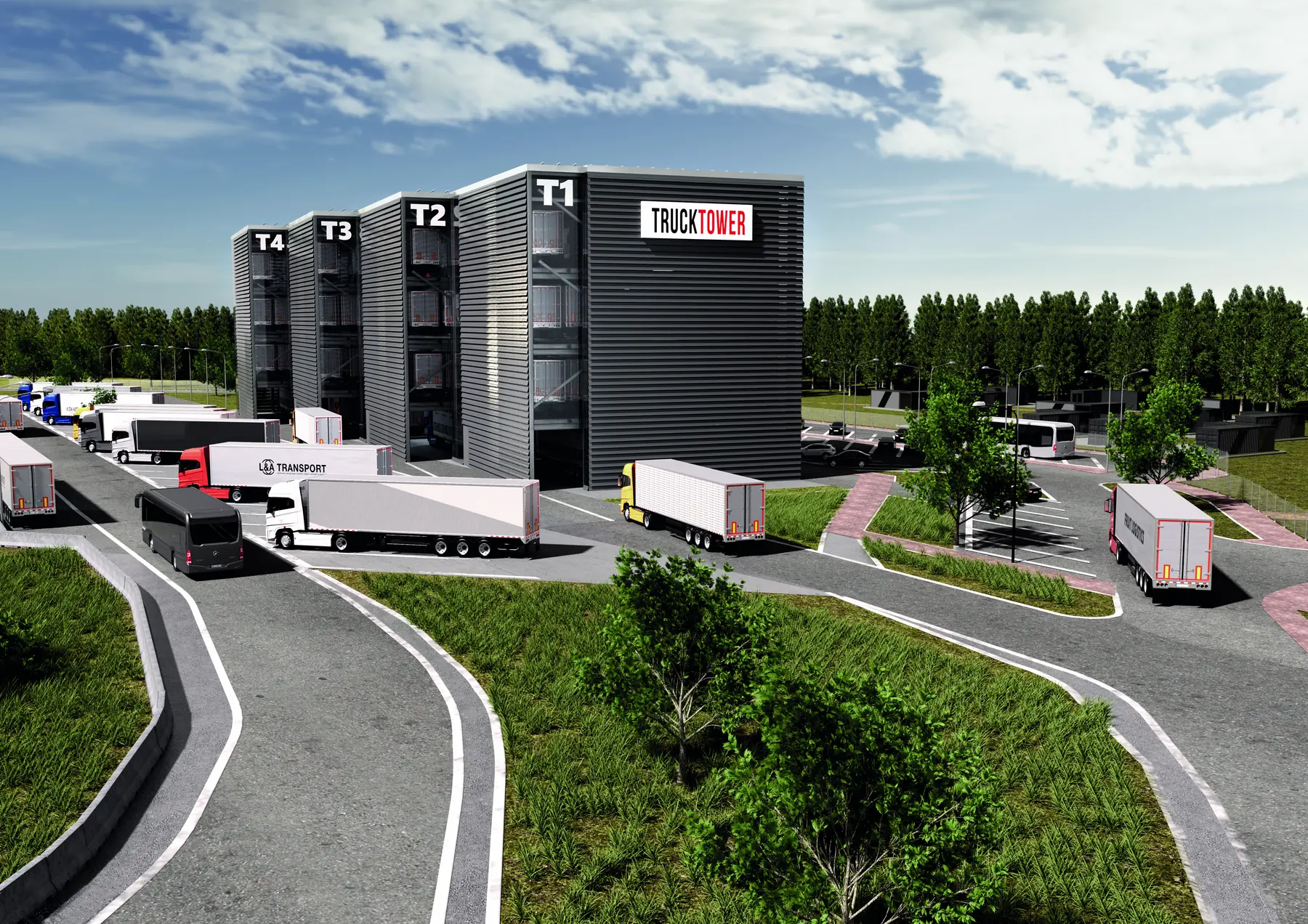
The enclosed building. Parking, charging and service on several levels, access-controlled and enclosed.
-
The Stack
The open structure. Erected at the edge of the working yard and grows column by column with demand.
-
Automated instead of self-driven
The driver hands over at ground level. After that the facility takes over; there are no ramps and no driving lanes up above.
-
Mixed fleet
From tractor units through swap bodies and roll-off containers to articulated buses, mixed within one facility if needed.
-
On existing ground
Construction is on what is already paved. No extra land, no new sealed surface.
-
Daily access
By schedule the vehicle is down at the agreed time; on demand it takes up to 1.5 minutes per vehicle.
Which route suits your site?
Send us the area and the fleet. We will also tell you if one of the other solutions suits you better.
Phone +49 7251 9760 620
Email [email protected]