

- Home
- Vision
Dense parking
is only the beginning.
TRUCKTOWER frees up parking space today. Our vision goes further: smart hubs where commercial vehicles can charge, receive services and be ready for the next journey.
A start-up with a building as its answer
Founded in 2023, TRUCKTOWER tackles a growing problem in logistics: where to park commercial vehicles when land is scarce. We turn existing sites into multi-level parking.
foundedbased in Bruchsal
more truck traffic between 2020 and 2050 estimate by the European Commission
more bus use over the same period estimate by the European Commission
growth in road freight by 2051 BMDV, now BMV
Sources: Transport & Environment and the German Federal Ministry for Transport (BMV), until 2025 the Federal Ministry for Digital Affairs and Transport.
Vehicles on pallets, as in a high-bay warehouse
The TruckTower uses an automated system to stack vehicles on purpose-built pallets, much like a high-bay warehouse. Vehicles are driven onto these pallets and secured automatically. Once the driver has parked, they step out.
A system of lifts and shuttle mechanisms then carries the pallets to their spaces in the vertical storage structure. This creates capacity on existing ground, without sealing any more of it.

A Europe-wide network of smart hubs
We envision smart hubs along Europe's transport corridors. Future sites could combine secure parking, charging and handovers between manual and autonomous driving.
In the city, a person drives
In urban areas and at the destination the drivers take control, where precise driving is needed.
On the motorway, the truck drives
On motorways and in rural regions the vehicles move autonomously. The riskier and more tiring long stretches run without a driver.
What that achieves
Splitting the journey this way reduces the strain on drivers, minimises the risk of accidents and raises the productivity of logistics operations.
Where we are taking the system
A hub for autonomous transport
Autonomous trucks will run the long haul, people the local delivery. In between, the vehicle has to be handed over somewhere: park it, check it, pass it on. That is what the facility already does with drivers today, and it does it without shunting space.
Sustainable infrastructure for Europe
Parking spaces stacked need less ground than parking spaces side by side. The same area holds more of them, charging points can be planned into the levels, and the ground that would otherwise be sealed stays open. Less land, less sealing, less compensation required.

A better workplace for drivers
Shunting on a full yard is the least pleasant part of the shift, and the most dangerous. Hand the vehicle over at the station and you avoid both. Once the long haul runs autonomously, local delivery is what remains: home at the end of the shift instead of a lay-by.

Multimodal logistics hubs
At terminals, trailers and swap bodies wait for the train or the ship. They stand side by side although they could stand on top of each other. Same technology, same structure, at the transfer point instead of the depot.

Digital innovation and security
Every storage and retrieval is a record: which vehicle, when, on which level, requested by whom. That gives an unbroken trail of who had access to the load and when. No extra component, but the basis for everything built on top of it later.

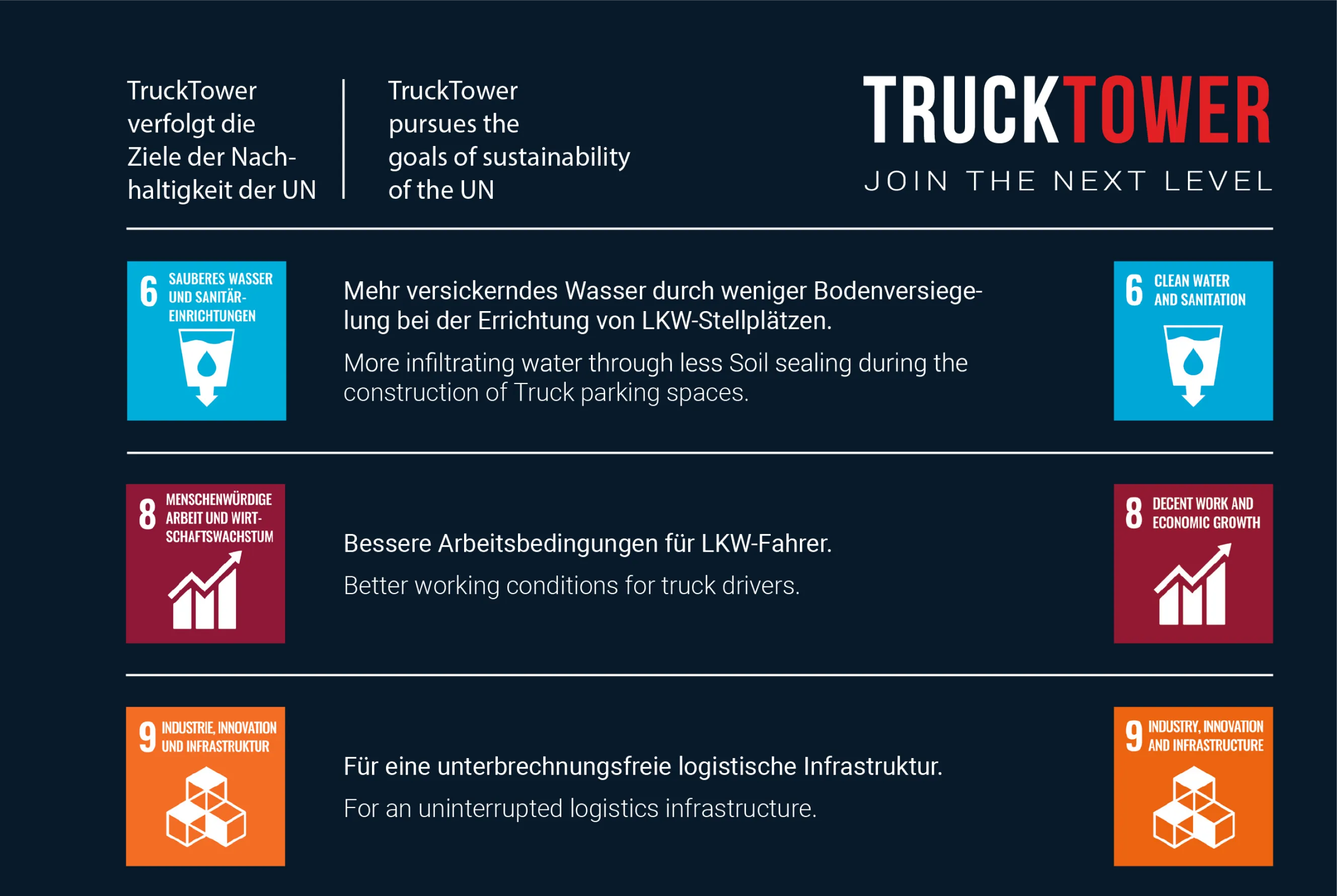
We follow the UN Sustainable Development Goals
Six points you can measure that against:
-
Less sealed ground
improves water infiltration and supports local ecosystems. -
Better working conditions
through rest areas and amenities for truck drivers. -
Efficient logistics infrastructure
reduces interruptions and makes supply chains more reliable. -
Less urban truck traffic
strategically placed facilities cut trips and improve air quality. -
Lower CO2 emissions
efficient parking systems avoid unnecessary trips and fuel consumption. -
Protecting woodland and green space
less sealed ground protects green spaces and their biodiversity.
From the first question to the warranty
Nine clear steps from site assessment to handover and support.
Contact phase
First conversation, clarifying scope and goal.
Information phase
Recording the site, the fleet and the processes.
Concept phase
Designing the version and capacity for your site.
Quotation phase
A firm quotation including options.
Order phase
Placing the order and detailed planning.
Production phase
Prefabrication of the system components.
Construction phase
Erection and assembly on site.
Handover phase
Commissioning, training, acceptance.
Warranty phase
Support and service during operation.
VerTIBUS
An overview of the project, just over three minutes.
Let us talk about your site
Share your site. We will explore its potential.